 Sketchglass
A 7-day drawing practice plan for beginners
Fifteen minutes a day, one new subject each day. By day seven you will have drawn shapes, an animal, faces, food, flowers, a car and a portrait.
In this guide
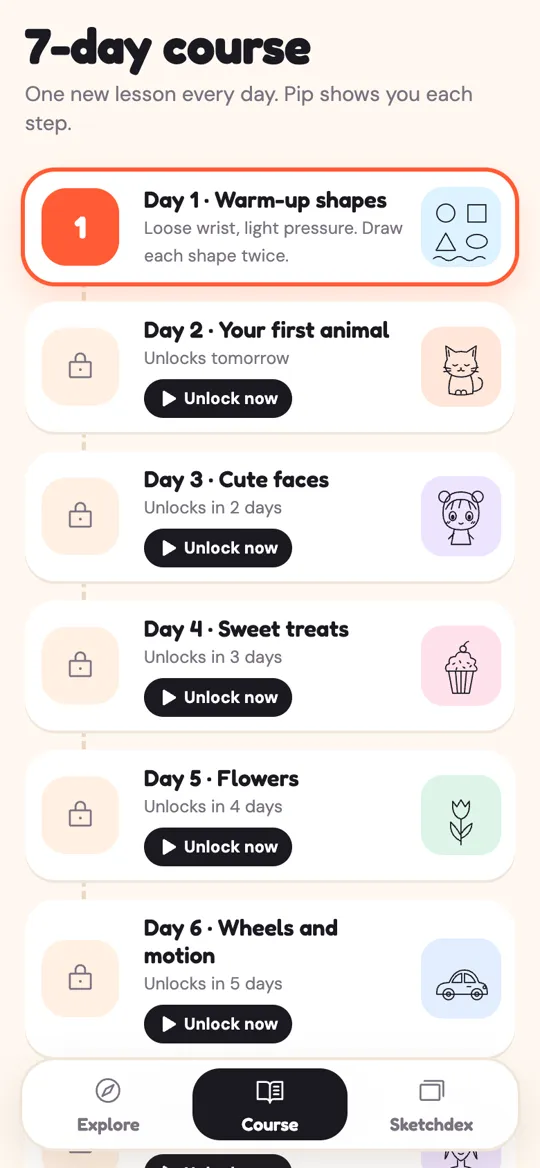
A good beginner drawing plan is short, daily and varied. Spend about fifteen minutes a day for a week: warm-up shapes on day 1, an animal on day 2, faces on day 3, sweet treats on day 4, flowers on day 5, wheels and motion on day 6 and a portrait on day 7. Each day has one tip to focus on, and you finish every session by redrawing part of it without help.
The hardest part of learning to draw is not talent. It is showing up. Long sessions are tiring and easy to skip, and most beginners stop after a few days because they do not know what to draw next.
A short drawing practice plan for beginners fixes both problems. This 7-day drawing practice plan gives you one subject per day, one tip per day and a small goal for each session. It is the same order as the 7-day course in Sketchglass, where one new lesson unlocks each day, but you can follow it with just paper and a pencil.
How to use this plan
Every day follows the same simple routine:
- Warm up for two minutes. Draw circles, lines and wavy lines across a scrap of paper.
- Do the day's lesson for ten minutes. Trace it or draw it while looking at a reference.
- Redraw one part freehand for three minutes. Pick the part you liked most and draw it again next to your lesson, without any help.
The third step matters most. Tracing teaches your hand the shapes; redrawing teaches your brain to remember them.
The 7-day drawing plan
Day 1: Warm-up shapes
Draw circles, ovals, squares and triangles, each one twice. Do not worry about perfect shapes, worry about smooth ones.
Tip of the day: loose wrist, light pressure. Draw each shape twice.
Day 2: Your first animal
Draw a sleepy cat. Start with a big circle for the head and a bigger oval for the body, then add ears, a face and a tail.
Tip of the day: big shapes first, details last.
Day 3: Cute faces
Draw a chibi character with a large head and a small body. Practise placing the eyes and the mouth.
Tip of the day: eyes sit halfway down the head. Most beginners put them too high.
Day 4: Sweet treats
Draw a cupcake with soft frosting and a cherry on top. Treats are great practice for curves.
Tip of the day: wavy lines make frosting look soft.
Day 5: Flowers
Draw a tulip with a stem and two leaves. Flowers are forgiving, so this is a relaxing day.
Tip of the day: curve the stem a little so it feels alive.
Day 6: Wheels and motion
Draw a little car. Vehicles teach you to place shapes in relation to each other.
Tip of the day: circles first, then connect them. Draw both wheels before the body so the car sits straight.
Day 7: Anime portrait
Finish the week with an anime-style portrait. It uses everything you practised: shapes, face placement and soft curves for the hair.
Tip of the day: hair is big shapes, not single strands.
Tracking your progress
It is easy to feel you are not improving when you only look at today's drawing. Keep every page from the week and lay them out on day 7. The difference between day 1 and day 7 is usually bigger than you expect.
In Sketchglass every finished drawing also becomes a card in your Sketchdex, with 1 to 3 stars depending on how closely your lines match the sketch. A streak counter shows how many days in a row you have drawn. Three stars on the day 7 portrait earns a Legendary card, which makes a nice reward for finishing the week.

What to do after day 7
Once you finish the week, you have a few good options:
- Repeat the week with new subjects. Swap the cat for a puppy, the cupcake for a donut and the car for a bus. The tips stay the same.
- Try a speed round. Sketchglass has a 60-second challenge for a speed card. Drawing fast stops you from overthinking each line.
- Draw something of your own. Use photo to sketch to turn a picture of your pet into line art, or trace your name in a graffiti font for the cover of your sketchbook.
- Pick a favourite subject. If dinosaurs were the most fun, our baby T-Rex tutorial is a good next lesson.
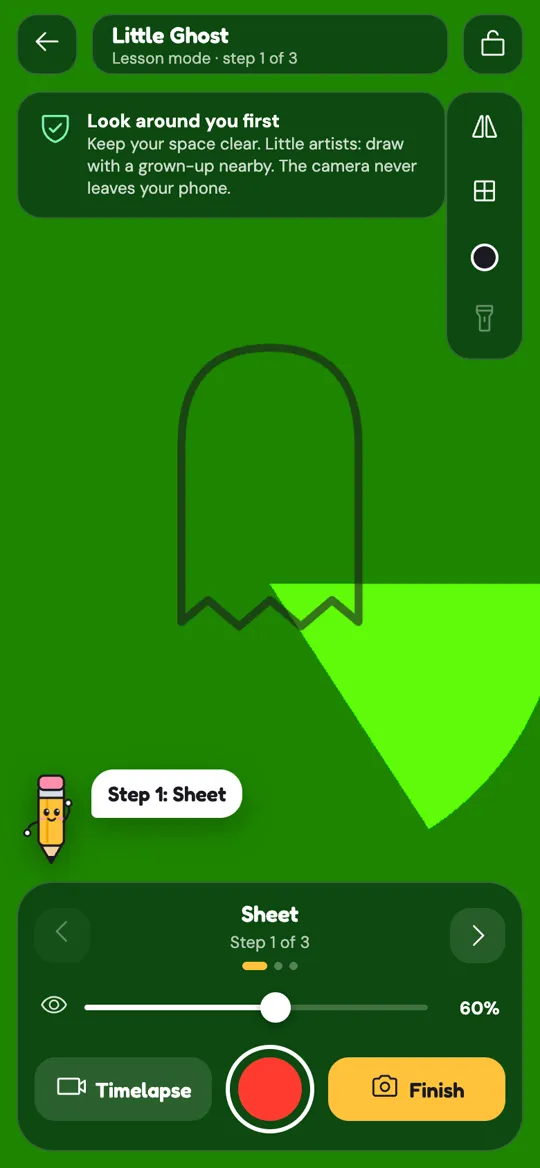
If you are new to tracing with a phone, read how AR drawing works before you start day 1, so the setup does not eat into your fifteen minutes.
Tips to keep going
- Same time every day. After school, after dinner or before bed. A habit sticks better when it has a home.
- Keep your kit together. Paper, pencil, eraser and a phone stand in one place means no time lost setting up.
- Stop while it is still fun. Fifteen minutes is enough. Ending on a good drawing makes tomorrow easier to start.
- Missing a day is fine. Pick up the plan where you left off rather than starting over.
FAQ
How long should a beginner practise drawing each day?
Around fifteen minutes is a good start. It is long enough to finish a small drawing and short enough to do every day, which helps more than one long session a week.
Is tracing good practice for beginners?
Yes, when you mix it with drawing on your own. Tracing trains line control and shows you how shapes fit together. Redrawing a part freehand right after tracing helps you remember it.
What should I draw on my first day?
Start with simple shapes: circles, ovals, squares and triangles. They are the building blocks of almost everything else, from animals to cars.
Do I need an app to follow this plan?
No. You can follow every day with paper, a pencil and a reference picture. Sketchglass adds the sketch over your paper, step-by-step lessons and cards to track your week.