 Sketchglass
How to draw a sleepy cat in three easy stages
Two curved lines turn an ordinary cat into a dozing one. Here is the simple order for the head, the sleepy face and the body, using the Sleepy Cat sketch as our example.
In this guide
To draw a sleepy cat, start with a wide, round head and two pointed ears on the top corners. Next draw the dozing face: two small U-shaped curves for closed eyes, a tiny triangle nose, a soft "w" mouth and two whiskers on each cheek. Finish with a small sitting body, two round front paws and a tail that curls up at the side.
A cat is a lovely first animal to draw, because it is built from shapes you already know: a round head, two triangles and a few curves. This guide shows you how to draw a sleepy cat that sits up straight with its eyes shut, the way cats do when they doze off in a sunny spot.
We follow the three stages of the Sleepy Cat sketch in Sketchglass: Head and ears, Sleepy face, and Body and tail. A pencil and a sheet of paper are all you need. There is a short section on tracing near the end, if you want to learn the shapes that way first.
What makes a cat look sleepy
A drawing looks sleepy because of a few small choices, not because of extra detail:
- Closed eyes. Two little curves replace round, open eyes. This one change does most of the work.
- A tiny mouth. A small, relaxed "w" under the nose looks content. A wide open mouth looks awake and noisy.
- A still pose. The cat sits upright with its paws together and its tail tucked beside it. Nothing is jumping or stretching.
- Soft, round lines. Round cheeks and a rounded body look cozy. Sharp zigzags look alert.
Keep those four things in mind and the dozing mood comes almost by itself.
What you need
- Paper (printer paper is fine)
- A pencil, ideally HB or 2B
- An eraser
- A black pen or fine marker for inking, if you like
- Coloured pencils or markers (optional)
Draw lightly at first. The tip for this lesson in the app is big shapes first, details last, and it is good advice on any paper: get the head and body in place before you worry about whiskers.
Stage 1: Head and ears
The head is the biggest shape in this drawing, so start in the top half of your page and leave room below for the body.
- Draw the top of the head. Make a short, gentle curve, almost flat. This is the space between the two ears.
- Add the ears. From each end of that curve, draw a line up and outward to a point, then back down to where the side of the head will start. You now have two triangles that lean slightly away from each other.
- Draw the cheeks and chin. From the bottom of one ear, curve out and around, under the face, and back up to the other ear. Make the head wider than it is tall, with the widest part low down at the cheeks.
- Add the inner ears. Draw one short straight line inside each ear, running from near the tip towards the head. That single line is enough to show the inside of the ear.
Check that both ears are the same height, and fix any lopsided cheek now while the lines are still light.
Stage 2: Sleepy face
This is where your cat falls asleep. Every part of the face is small, so take your time.
- Draw the closed eyes. About halfway down the head, draw two small curves shaped like the letter U, one on each side. Space them well apart. They should look like two tiny smiles.
- Add the nose. In the middle of the face, a little below the eyes, draw a tiny triangle that points down. Fill it in.
- Draw the mouth. From the bottom tip of the nose, draw one small curve that hooks out to the left and one that hooks out to the right. Together they make a soft "w".
- Add the whiskers. On each cheek, draw two straight lines that start beside the mouth and reach out to the edge of the face. Let them fan apart a little, one tilting up and one tilting down.
If you make the eye curves the other way up, like little hills, the cat looks happy and laughing instead of asleep. Both are cute, so pick the mood you like.
Stage 3: Body and tail
The body is smaller and simpler than the head. Think of a soft, rounded bell sitting under the chin.
- Draw the sides. Start just under each cheek, a little way in from the edge of the head. Bring each line down with a gentle outward curve. The body should be narrower than the head and shorter than it too.
- Close the bottom. Join the two sides with a slightly curved line. Your cat is now sitting on the ground.
- Add the front paws. At the bottom middle of the body, draw two small arches side by side, like two upside-down U shapes that touch. These are the paws tucked neatly together.
- Draw the tail. From low on one side of the body, draw a line that sweeps out, curves upward and hooks back in towards the cat at the top. A single curved line reads as a tail straight away.
- Ink and colour. Go over the lines you like in pen, let it dry, erase the pencil, then colour. Orange, grey, black and white patches or tabby stripes all suit a dozing cat.
Want to make it extra drowsy? Add a few small letter Zs floating up from one ear. The sketch does not have them, but it is your cat.
Learning the shapes by tracing first
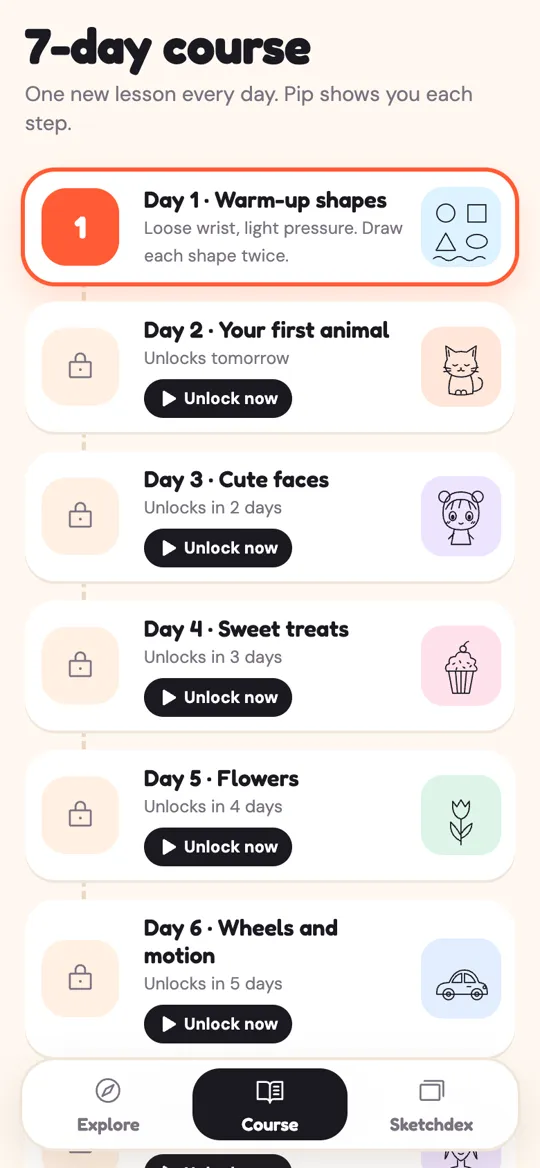
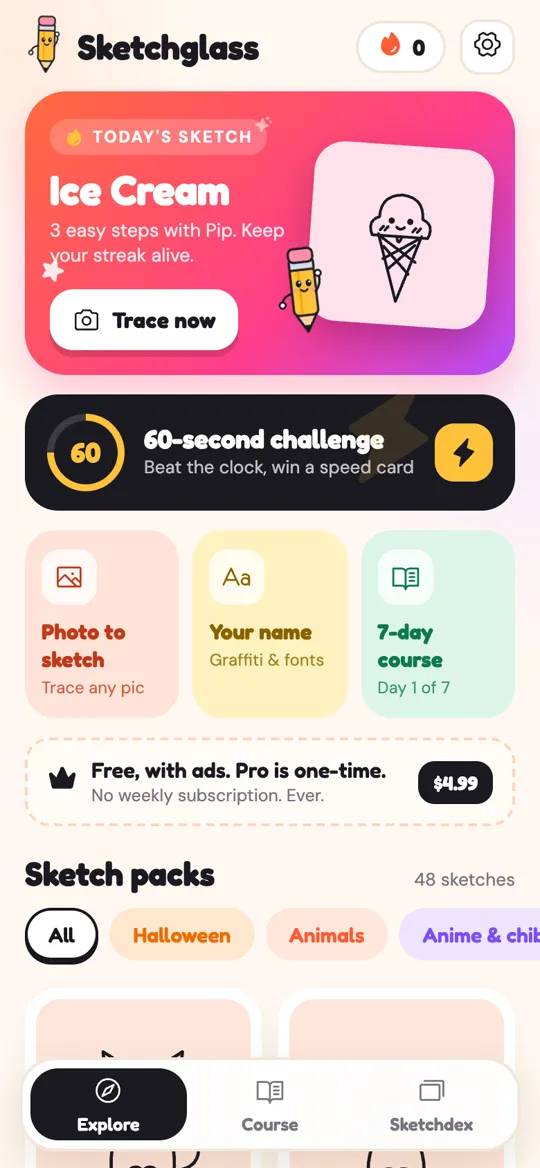
If the head keeps coming out lopsided, tracing it a few times helps your hand learn where everything goes. Sleepy Cat is a free sketch in the Animals pack in Sketchglass, split into the same three stages as this guide, with Pip the pencil showing one step at a time. It is also the sketch for Day 2, Your first animal, in the 7-day course.
- Prop your phone on a glass or a stack of books, about a hand above your paper.
- Open Sleepy Cat from the Animals pack.
- Pinch, drag and twist the sketch into place, then lock it.
- Trace stage by stage, then snap your finished drawing to get your stars and a Sketchdex card.
If the sketch slides around while you trace, our guide to setting up your phone for AR tracing covers the stand, the height and the light. And if your curves come out shaky, a minute of warm-up from drawing smooth, confident lines makes the cheeks and tail much easier.
Common mistakes and quick fixes
- The cat looks surprised, not sleepy. The eyes are too big or too round. Shrink them to short, shallow curves.
- The ears look like horns. They are too tall and thin. Make each ear a wide triangle that sits on the corner of the head.
- The head looks like a ball on a stick. The body is too narrow. Start the sides closer to the cheeks and curve them outward.
- The face feels crowded. The eyes, nose and mouth are too large. Keep them tiny and leave plenty of empty cheek around them.
- The tail looks stiff. It is too straight. Give it one big sweeping curve with a hook at the end.
Once this cat feels easy, try another animal built the same way. Our cute baby T-Rex guide uses the same idea of big shapes first and details last.
FAQ
How do you draw closed cat eyes?
Draw two small curves shaped like the letter U, about halfway down the head and well apart. Keep them short and shallow. Curves that point down look asleep, and curves that arch up look happy.
What is the easiest cat to draw for beginners?
A sitting cat seen from the front is the easiest. It is a wide round head with two triangle ears, a small rounded body, two front paws and one curved line for the tail, so there are no tricky legs to work out.
How many whiskers should I draw?
Two on each cheek is plenty for a simple cartoon cat. Draw them as straight lines that fan apart slightly. More whiskers can make a small face look busy.
How can I make my cat drawing look more sleepy?
Keep the eyes closed and the mouth tiny, sit the cat upright with its paws together, and add a few small Zs floating above its head. Soft colours and round shapes help the cozy mood too.
Is Sleepy Cat free in Sketchglass?
Yes. Sleepy Cat is one of the free sketches in the Animals pack. It is also the Day 2 lesson, Your first animal, in the 7-day drawing course.